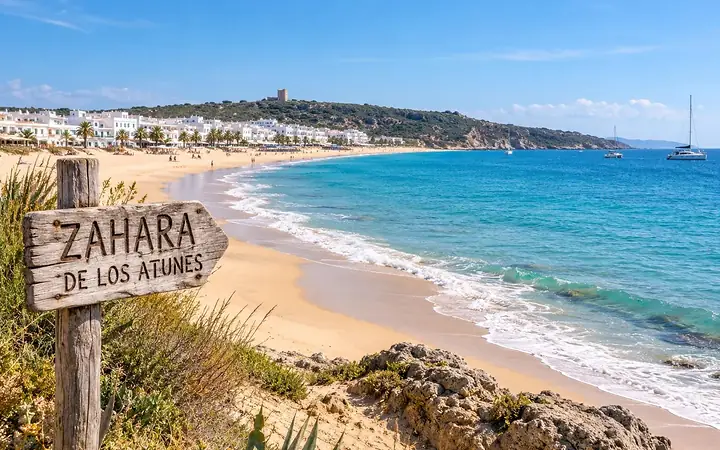
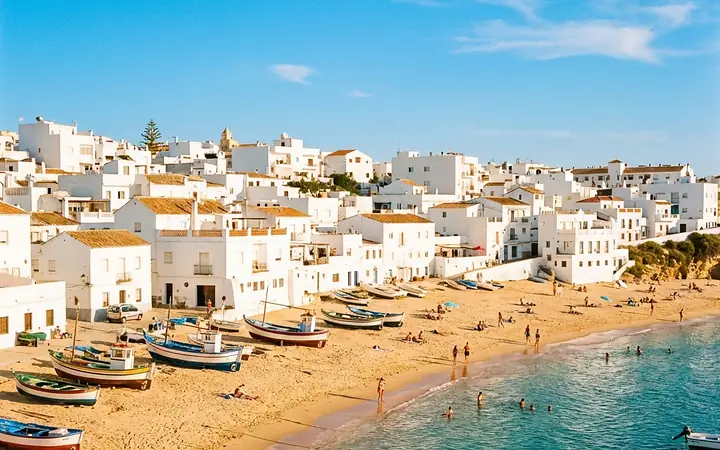
The Costa de la Luz, the Atlantic coast of Cádiz province, has some of the finest beaches in Spain and no big airport of its own. Jerez has a handful of routes and Seville is inland; Málaga, two to two and a half hours east, has flights from almost everywhere at almost every hour. That is why a large share of the people on the beach at Zahara or Bolonia arrived through Málaga's Terminal 3.
This guide is about that journey: how long it really takes to each town, which roads it uses, what the wind does to plans, how kitesurfing gear travels and why the longer routes ask for two days' notice.
Distances and times from the arrivals hall
The coast unrolls in order from Málaga. Tarifa is 160 kilometres and about 110 minutes. Zahara de los Atunes is 195 kilometres and 135 minutes, with Bolonia a similar distance by a different turning. Vejer de la Frontera, up on its hill, is 205 kilometres and 140 minutes; Conil 215 and 150; Chiclana and Sancti Petri 225 and 155; Cádiz city 235 and 160. Those are fixed-price transfer times on the toll road and the dual carriageways, without traffic.
The pattern is worth noticing: after Tarifa, each town is roughly ten minutes further than the last. For a group splitting between two towns, a single vehicle dropping at both is often simpler than two transfers.
- Tarifa: 110 min.
- Zahara and Bolonia: about 135 min.
- Vejer and El Palmar: 140 min.
- Conil: 150 min.
- Cádiz: 160 min.
The roads: AP-7, N-340 and A-48
The first eighty minutes are the AP-7 toll motorway to its end at Guadiaro, then the free A-7 around the bay of Algeciras. From Algeciras the N-340 climbs over the hills of the Estrecho natural park, with wind farms on the ridges and Morocco across the water, and drops into Tarifa. Beyond Tarifa the N-340 continues as a single carriageway past the turnings for Bolonia and Zahara until it becomes the A-48 dual carriageway near Vejer, which runs on to Conil, Chiclana and Cádiz.
A transfer with a fixed price does not include the toll sections. The N-340 stretch is the slowest part: about 40 kilometres of two-lane road with lorries heading for the port, which is why the times above are longer than the distances suggest.
Key takeaways
- Málaga's flight choice is why the Costa de la Luz fills through Terminal 3, despite two hours on the road.
- Tarifa 110 minutes, Zahara 135, Vejer 140, Conil 150, Cádiz 160, on the toll road and dual carriageways.
- The N-340 between Algeciras and Vejer is the slow, two-lane part of the drive.
- Levante days: sheltered beaches at Bolonia and Zahara; kiters go to Valdevaqueros.
- Boards travel flat in the estate car or minivan; book long routes 48 hours ahead and the return with the outbound.
Levante and poniente: the wind decides the beach
The Strait of Gibraltar has two winds. The poniente blows from the west, cool and steady, and makes the beaches near Tarifa pleasant. The levante blows from the east, hot and strong, sometimes for a week, and turns Los Lances into a sandblast while filling Valdevaqueros with kitesurfers. Bolonia and Zahara, tucked behind headlands, are more sheltered on levante days.
For the drive, the levante means gusts on the hills above Tarifa and nothing more; our drivers slow down and it adds nothing to the timing. For the holiday, it means checking the forecast before choosing the day's beach, and packing a windbreak.
Kite, surf and boards as luggage
Tarifa is Europe's kitesurfing capital and El Palmar its surf beach, so a lot of luggage on this route is boards. Board bags and kite quivers come out on the oversized belt at Málaga Airport. In the car, they travel flat: an estate car takes a board bag and a quiver with two passengers and their cases; a group of four with full gear needs the minivan. Tell the transfer company how many bags, and their length, when you book.
Schools in Tarifa and El Palmar rent complete kits, so flying light and hiring on the beach is a real option for a first trip.
The 48-hour rule and what the day looks like for the driver
Local transfer companies ask for at least 48 hours' notice for the Costa de la Luz because a run to Zahara or Cádiz occupies a vehicle and a driver for most of a day: two and a half hours out, the same back, plus the time at the airport. With two days' notice the car is guaranteed; with less it depends on what is already booked, and it is worth asking by email rather than assuming.
The same logic applies to the return. Book it with the outbound, give the flight time and the company plans the pickup: journey time plus two hours at the terminal, two and a half in summer or for flights outside Schengen, which means leaving Zahara about four and a half hours before a summer flight to the UK.
Ferries, whales and combining towns
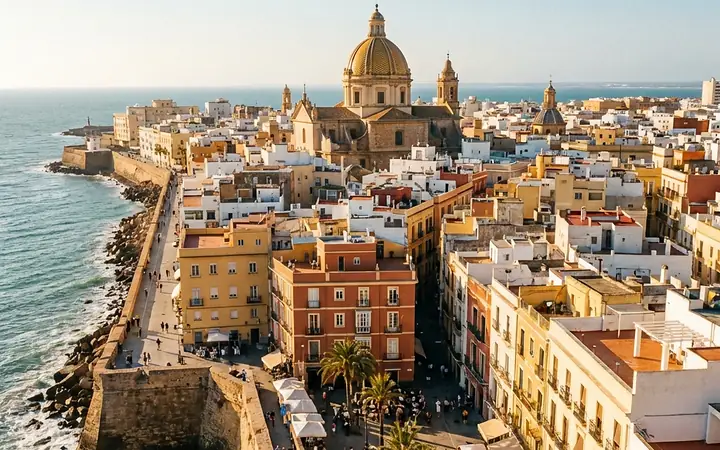
Tarifa's port has a fast ferry to Tangier, and whale-watching boats leave from the same harbour most of the year; a transfer can drop at the terminal directly. Many travellers combine two bases, Tarifa for the wind and Vejer or Conil for the villages and the calmer beaches, and a local company will quote fixed prices for the hop between them. Cádiz, with its old city and its Carnival, is the natural end of the road and the subject of its own guide.
Get your fixed price
Pay the driver on arrival. No card needed now.