Spanish traffic law is clear and strictly applied: children shorter than 135 centimetres must travel in an approved child restraint suited to their size, and as a rule in the rear seats. That applies to taxis and transfer vehicles as much as to private cars, and it is the reason a family arriving at Málaga Airport with a toddler should never rely on finding a seat at the taxi rank.
This guide explains the rule, which seat fits which child, how to handle pushchairs and luggage, and what to ask for when booking so that the car waiting for you already has the seats fitted.
The rule: 135 centimetres and the back seat
Under Spain's traffic regulations, any passenger up to 135 cm tall must use a child restraint system approved for their weight and height. Children of that size may only travel in the front seat in specific cases, such as when the vehicle has no rear seats or all rear seats are already occupied by other children in restraints. Between 135 and 150 cm the seat belt alone is allowed, though a booster is still recommended. Police enforce this with fines, and more importantly the rule exists because adult belts sit on a child's neck and abdomen.
Taxis are the one traditional exception: in urban journeys they may carry children without a seat in the rear. That exception does not extend to the motorway, and it does not make an unrestrained child safe on the AP-7 at 120 kilometres an hour. A pre-booked transfer with seats fitted is simply the correct way to do it.
Which seat for which child
Three types cover almost every child. A baby seat, rear-facing, for infants from birth to roughly one year or thirteen kilos. A child seat, forward-facing with its own harness, for roughly one to four years, or nine to eighteen kilos. A booster, with or without a back, for children from about four years up to 135 cm, which uses the car's own belt positioned correctly. Age is a rough guide; weight and height decide.
If you are unsure which type your child needs, say the age and height when booking and the company will choose. In our cars all three types are free of charge and fitted before the driver leaves for the airport, so nothing is improvised in the arrivals hall.
- 0-1 year, up to about 13 kg: rear-facing baby seat.
- 1-4 years, about 9-18 kg: forward-facing seat with harness.
- 4 years to 135 cm: booster with the car's belt.
Key takeaways
- Children under 135 cm must use an approved seat in Spain, in the rear seats; the taxi exception does not cover motorway transfers.
- Baby seat to about one year, child seat to about four, booster to 135 cm; age is a guide, weight and height decide.
- Pushchairs come out on the oversized belt; a family with cot and pushchair needs the estate car or the minivan.
- Book seats in the form so they are fitted before the driver leaves for the airport.
- For Costa de la Luz drives, request a comfort stop and keep snacks in the cabin.
Pushchairs, cots and the luggage that comes with children
A pushchair travels free on most airlines and comes out on the oversized belt at Málaga, not the flight belt. A folded pushchair fits in the boot of a sedan with two suitcases; with a travel cot, a bag of beach equipment and four cases it does not, and the estate car or the minivan is the right choice. Travel cots can be borrowed from many hotels and villa agencies, so ask before you pack one.
In the vehicle, the pushchair goes in the boot and the child seats stay fitted for the return journey if you have booked both ways, which is one reason to book the return at the same time.
Why the taxi rank is a gamble with children
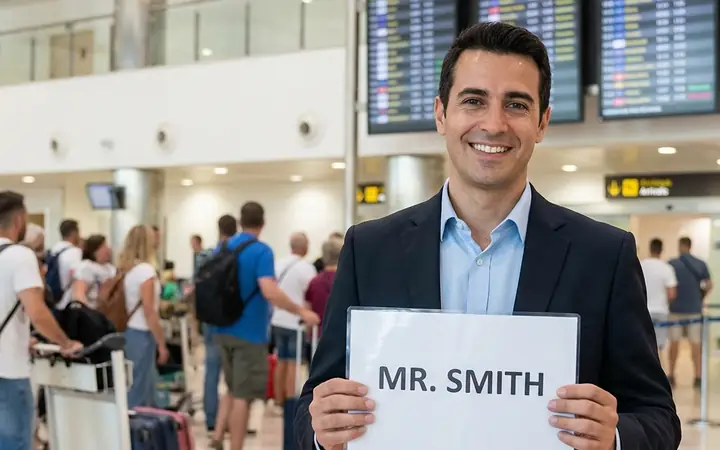
The taxi rank at Málaga Airport works well for adults, but the taxi that reaches the front of the queue is the one you get, and very few carry child seats. You can ask, wait for one that does, or accept a journey without. None of these is a good start to a holiday at midnight with a tired toddler. A transfer booked in advance with seats specified in the form removes the problem: the driver is in the hall with your name and the seats are already in the car.
It also fixes the price. With a family of four, two suitcases, a pushchair and two seats, a per-vehicle fixed price from a local company is usually no more than a metered taxi and includes free waiting time if the baggage belt is slow, though not the motorway toll.
Long drives to the Costa de la Luz with children
Transfers from Málaga to Tarifa, Conil or Cádiz take two to three hours. With small children, plan the drive rather than endure it: a comfort stop can be requested when booking, and the driver will suggest a place with toilets and shade around the halfway point near Algeciras. Bring water and snacks in a bag you keep with you rather than in the boot, and a sun shade for the window on the south side.
Timing matters. A morning flight puts the drive in the heat of the day in summer; an afternoon flight puts it in the late afternoon, when children often sleep. If you have a choice of flights, the later one is frequently the easier drive.
Booking checklist for families
Number of passengers including every child, because a baby counts as a passenger for the vehicle size. Age and height of each child needing a seat. Number of suitcases and whether there is a pushchair or a cot. Flight number, so the driver tracks it. The name of the accommodation and, for a villa, the phone number of the key-holder. With that in the form, the car that meets you is the right size, with the right seats, at the right time.
Get your fixed price
Pay the driver on arrival. No card needed now.